Thursday, April 15, 2010

Van: Day 2


Saturday was to be our long day. We drove northeast along the edge of Lake Van, headed toward Ishak Pasha Sarayi, not far from Mt. Ararat. The scenery was stunning and there were sheep everywhere. Apparently, livestock was a very big part of the economy until the fighting broke out between the Turkish army and the Kurds. It's referred to as a war, actually. It sent thousands of Kurdish refugees into the cities, particularly those of eastern and southeastern Turkey. This particular shepherd had been a long-haul trucker before retiring to his farm. He actually invited us to come to his house to drink tea, but we had to get back on the road. This wasn't the last stop we made to take pictures of sheep.

Our first stop was Muradiye Falls. As it's prime snow melt time, they were really roaring. Actually, we stopped a bit earlier at a much small water fall, really water rushing through a gorge and under a bridge. It was here I spotted what I think was a White Wagtail.


From the falls to Caldiran, locate on the edge of a beautiful plain ringed with mountains. Actually the plain is famous for a very famous battle that took place between the Persians (speciffically the Shafavid Dynasty) and the Ottomans in 1514. The Ottomans beat the Persians decisively, thereby gaining control over Eastern Anatolia. We stopped there for tea -- tea breaks are very Turkish. Actually, it was good to get out of the car. There was some sort of celebration going on -- political in nature, but we never did find out exactly what it was. Then we drove across a pass. For what seemed like quite a while we drove through lava beds that reminded me of the Malpais in New Mexico. As we went over the pass we got a good view of the volcano Mt. Tenduerek. It was beautifully clear. Interestingly, when we drove back later that afternoon we encountered snow flurries.

As we came down from the pass, there was a view of Mr. Ararat across the valley. Unfortunately, all we could see was the base of the mountain. However, living with the comings and goings of Mr. Rainier, I'm used to that. We drove on the the Iranian border crossing where we got a look at Little Mt. Ararat.

Little Mt. Ararat. The Big Mr. Ararat is to the left, mostly hidden in the clouds.


Turkish and Iranian flags at the border.
This is probably as close as I will get to Iran. If you click on the picture and look in front of the red bus, you'll see the face of an Ayatolla -- they said Khomeini but I don't think that's correct. Actually, one of the reasons we made the trip right to the border was to get into the Duty Free Shop. In theory, on those who have come across from Iran and not yet passed the last Turkish checkpoint can shop there. However, our guards drove right around the checkpoint. Unfortunately, "we" weren't able to buy anything, because the person on duty said they were being watched for just such activities. I use the term because it was really our guides who wanted to pick up some stuff from that store.

From the border we drove back to Isak Pasha Sarayi (castle). They have just finished a major renovation. Sadly, the Russians burned it during the First World War. The portal was gold plated -- and is now on display in the Hermitage. They also took all the books out of the library. Since the roof burn, the castle was exposed to the elements until fairly recently. As you can see from the photo below, they have built raised roofs with clerestory windows over the exposed areas. These window let in a lot of light.

Isak Pasha Sarayi from above

The castle isn't that old, by Turkish standards. It was built in 1785 and not completed until sometime in the 19th century. The builder, Isak Pasha, was a local chieftan of either Kurdish, Armenian or Georgian decent. Actually this was more of a residence than military installation. The Russians burned the castle during the First World War. The portal was gold plated and can now be viewed in the hermitage. And the took all the books from the library as well. Don't know where they are.

The dining room in the palace. Notice the roof. It really does let in a lot of light without distracting. Very nice approach to the restoration.

One of the fourteen bedrooms, each with its own fireplace and fabulous view of the valley below


Of course, Isak Pasha was not the first to build on this site with its strategic location the silk road. Across a small gully from the palace you can see a mosque built by Selim II, who defeated the Persians in the decisive battle at Chaldiran. You an also see the remains of a Urartian fortification.

After what had been a long day, we had a late lunch in Dogubeyazit. They had regular tables but we chose Turkish style. One of our guides said he had just such a table at his house.

Driving back to Van we spotted this next from the road. We drove into the village and sure enough, there was a stork in it. What fun.

Almost back to Van we stopped at a place where you could by salt "distilled" from local water. It turned out the proprietor was busy grilling pearl mullet, a kind of fish that lives only in Lake Van. It was quite tasty. It turns out to be pearl mullet season. One of our guides had stopped and purchased some for his father from a roadside merchant.


Our last stop for the day was Van Castle. The original Old Van was on the back side. It was razed by the Ottomans during World War I, ostensibly to keep the Russians from getting it. Actually, the poor city had changed hands between them several times. I always feel sorry for the citizens when empires clash.


This is one of the gates into the old city through what remains of the original wall. In the background is one of two remaining mosques. This one has been painstakingly restored. The other is locked up and is apparently just a shell.


On the right you see all that remains of what was once an Armenian church. I have been told that "Van" means city in Armenian. The Van basin was the center of an Armenian dynasty, the Atzruni dynasty. At the time of its demise, this walled city housed about 80,000 people; the rest of the population lived on farms and orchards outside the walls. It must have been lovely.


My artistic picture, a ray from the sun setting over Lake Van -- taken from the portico of the restored mosque. A great way to finish a great day.

Wednesday, April 14, 2010

Van: Day I

View from what's left of Old Van into the mountains behind the city. The look much closer in real life.

Van, located in eastern Turkey not far from the Iranian border, had been on my list of sites to visit from the very beginning. I'd seen pictures of Van Lake and the surrounding mountains and found them quite inviting. Also my sister and brother-in-law inherited a cat they believe to be a Van cat, very special indeed. I just had to go check it out. Finally, that part of the country is more unknown to westerners and hence more mysterious. So when spring arrived, I bought myself a plane ticket, booked a hotel room, got the name of a guide and took off. Fortunately, one of my colleagues heard I was going and decided to come along.

My first impression after getting out of the plane was awe. The mountains seemed so close. It was much more spectacular than I had expected. My traveling companion was actually coming on a plane from Istanbul, arriving a couple hours after I touched down, so I took a taxi into town, checked into the hotel and started exploring. The old city of Van was actually razed by the Ottomans during the First World War. They had been fighting with the Russians over it's possession, and the city actually passed between them a couple of times during the early 20th century. The old city had been located at the foot of Van Castle, right on the lake. The new city was built a few miles inland. Architecturally, it's not at all interesting, mostly four or five story square buildings. But the streets are mostly laid out in a comprehensible fashion and are broad enough to accommodate traffic. There is also an energy and openness around the city, something you can really feel.

We called the guide after getting settled into the hotel. He and his partner came to the hotel to discuss what we'd be doing for the next couple of days. The one thing I wanted to do that afternoon was to visit a weaving cooperative I'd read about. It is a charitable trust set up to aid poor village women by paying them a fair wage for their work, and the profits go to a community health care project. I had been wanting to by a Turkish rug but had no idea how to do it without having to deal with the rapacious rug merchants. This seemed like the perfect solution.

The two guides decided they would accompany us since they hadn't heard about the place and wanted to check it out. It turned out to be difficult to find and when we got there it was closed. Someone went and got the key to let us in, but it appears that the coop might be closed for a couple of months. There was one spacious, well-lit room with probably a dozen looms set up. Most were empty but some had works "in progress."

A rug on a standard loom. Note the CD player on the left.


The loom is strung and ready to go. All the yarn is colored with natural dyes.

Having had no luck at this cooperative, our guides took us to another rug place that has EU support for teaching young village girls both rug making and life skills such as basic hygiene, child care, etc. They had room after room of rugs, both the woven kilims and the knotted rugs.


This is just one room. They had just about anything you could possible want in any shape and size.


Above is one of the students at the school. Notice that she has a knife in her left hand. After tying a knot, she expertly swings that knife out and cuts the threads so quickly you hardly realize she's done it.


And I did get to see Van cats. They are special for several reasons. First, they like the water. Also many, but not all, of them have one blue eye and one black eye. And because it gets cold in Van in the winter, they grow a large ruff around their necks. There is actually a Van cat institute at the university there. That's where most people go to see them. However, I got to see my cats at the rug place, so we didn't need to make that stop.


That night we had dinner in our hotel, Otel Tamara, in case you hadn't guessed. It's a famous Ocak (pronounced Ojak) restaurant. An Ocak is simple a grill in the middle of the table. It looked to us like the fuel for the grill was hazel nut shells. You pick out your meet from a cooler. We selected lamb shish kebabs, little lamb steaks and chicken shish kebabs. They also bring sliced tomatoes, onions, stuffed mushrooms, and green peppers (the hot kind) to grill along with the meat. Of course there is bread, meet and salad. We actually spent two lazy hours at the table. There was traditional music playing on a bandstand and we just went very slowly. Great way to end the day.

Monday, April 12, 2010

Antakya R & R

Reading a mystery novel on the bus to Antakya -- ah, such luxury

The last week of our Spring I term was stressful, to say the least. It was the regular final exam week. Then, in its infinite wisdom, the university decided to use that same time to select the 27 Zirve students whom the will send to the University of North Texas for a term. Zirve used this offer to recruit its first class of students. The teachers began fielding questions about the program early in the school year. By the end of the the second term -- approaching the end of December, the teachers and Texas administrators formed a committee to draw up procedures for selecting students. It took a while but we finally came up with something that appeared sensible. Of course, it languished "upstairs" and it was not until term three that students were invited to apply -- nearly 400 of them applied for 27 slots. Since it takes a while for the students to get passports, be issued I-20 forms and get visas, we were really coming down to the wire. It was decided to select something like 52 students for an interview. The students to be interviewed were given a letter as they exited their last final exam. Of course, the other students figured it out and couldn't concentrate on their exams. What a mess. And then we had to interview them all that afternoon, a process that was expertly organized by one of the Texas staff.

As if that weren't enough, there was a parallel process going on for the Turkish teachers. Zirve had promised to send 5 of them to Texas for a term for advanced teacher training. You can imagine. The place was so tense that air almost crackled. My colleague Judy and I decided to get away from it all and go to Antakya -- the third time for both of us. It was also her last weekend in Turkey before leaving to take a job in the Cayman Islands.

Since we had both been there a couple of times and seen the standard tourist sights, this was just to be a trip for relaxing. We alternated between lazing in coffee houses with views to walking the neighborhoods. However, our first stop was the little shop that serves nothing but hummous and bakla. (See the last entry on Antakya) Bakla is made from fava beans, cooked and mashed with olive oil, tahini, lemon juice, garlic, red pepper, salt and pepper. It's served with a flat bread and assorted pickles, olives, etc. We've actually had some luck making it at home, but always have questions for the cook. This time we found out he cooks the beans for 12 hours. Sounds like a candidate for crockpot cooking to me. Anyhow, we then went to the bazaar and bought the kind of pestle you need to mash the beans properly.


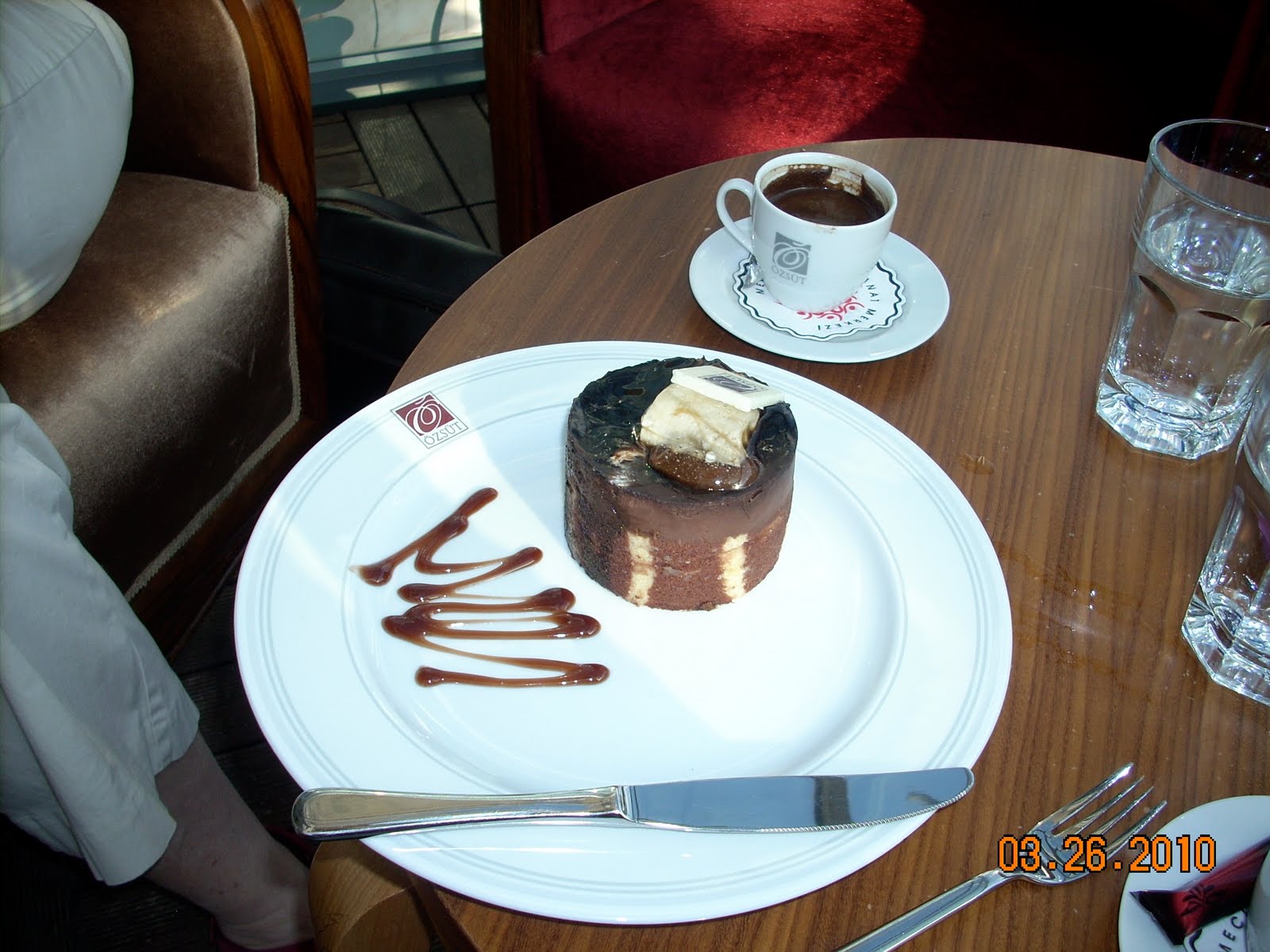
After lunch we started the hunt for a hotel room. We'd assumed we stay in the standard place, but they were booked -- as were the next two we tried. We ended up in a large hotel on the river. It's new and pretty ugly on the outside but we were delighted with our room. After that we settled into a nice second-floor coffee shop for Turkish coffee and a banana-chocolate pastry we split.


Cafe Ozsut

Having lingered long over our dessert and coffee, we ventured forth into the city, wandering back street to find our favorite soap place. We stocked up and then walked back to the hotel though the bazaar. We found that someone had left a fruit basket in our room -- which, by the way, was on the fifth floor overlooking the river and with a great view of the mountains. Since no one knew where we were staying, we assumed it must have been the management. We rested a bit and then went to a movie. There was a movie -- Shutter Island -- playing in English at a theater around the corner. We looked it up on the internet and it sounded like a who-done-it.Actually, it ended up being a rather disturbing movie, although very well acted by Leonardi diCaprio. When we returned to the hotel we thanked the young man at the desk for the fruit basket. He knew nothing about it. Who knows. Perhaps it was delivered to the wrong room. But we enjoyed it!

THe next morning after breakfast we decided to walk the neighborhoods on our side of the river, the new part of town. After that little jaunt, we stopped at Mado -- famous for its ice cream, for some wonderful freshly-squeezed juice and a latte. We sat in overstuffed chairs next to an open window and gazed up at the mountains. Wonderful.


Fresh juice of mixed fruits and a latte at MADO

Suitably refreshed, we decided to tackle the neighborhood that runs up the mountain on the old side of two. For some reason, I had thought that once you got a bit up the mountain and had a great view, the rents and quality of housing would rise. Not so. It is definitely not an affluent part of town, although they do have fabulous views. After winding though many small streets that we basically walls with doors that led to an inner courtyard of some sort, we came to a normal street that ran across the mountain. There was even bus traffic. However, we decided against climbing further, as we would be going up stairs that appeared to be too close to actual living quarters. It would have felt like we were intruding. So back down we went -- to our final bowl of bakla and bus ride home. Such a great weekend.

Friday, April 9, 2010

Can you guess what this is?

Oink, Oink.

It's hard to believe but yes, bacon! Canadian or back bacon or whatever. It was pork. One of our new teachers is a Scot. His parents live in Bodrum, in the western part of Turkey. There are a lot of ex-pats there, so they actually sell pork. He brought some back with him and very graciously shared. My friend and colleague Judy and I cooked up some scrambled eggs and had eggs and bacon. Now all we need is toast.

Sunday, March 14, 2010

Harran and Sanliurfa


Imagine Abraham's herds grazing on this very spot thousands of years ago.

Of course, God told Abraham to separate himself from everything that was going on in Harran and to move to the land of Canaan. Maybe it was what was going on in the tents!


Rochelle, Martha, Selda, Duygu and Judy

On a serious note, it was mind-boggling to stand on land with such an ancient history and to think that this is the very spot Abraham's father settled with his family after leaving Ur. Today Harran is an impoverished mostly Arabic-speaking village. It's a tourist destination for several reasons. One is the presence of what is called the first "university" in the world. It was an eighth century mosque complex where astronomical research was carried out. Very little remains of the original structure and it is fenced off. Guidebooks say you can see remains of a pool and seats that were part of the Arab "university." There is an on-going excavation project nearby, fenced off with a barb-wired topped chain link fence. So at least someone is paying some attention to this place.


Ruins of Mosque and Arab University


Another reason tourists come here is to see the "beehive houses." These are only a couple hundred years only -- practically modern! They're all made from mud bricks. Actually the houses in the village are now interspersed with more modern dwellings, and the old beehives used mostly for animals or storage. This is probably not a bad thing because it was the mud brick construction that caused houses to collapse during the recent earthquake that took place not too far north of Harran.


Looking into the courtyard of one of the complexes of mud brick, beehive houses.

There are also ruins of an old Crusader castle. You can scramble around and it looks like it's been shored up here and there. But it's still pretty much just ruins. It was the Mongol's who laid waste to the city -- like many other place in Turkey. However, unlike other places in Turkey, Harran never recovered.

From Harran we drove back into Sanliurfa, a city of about 400,000 east of Gaziantep. It's said that Urfa is 40 percent Kurdish, but probably that's too high. There are also Arabic speakers living there. It has a very different feeling from Gaziantep, whose population had been 30-40 percent Armenian prior to the First World War. Urfa is know for religious conservatism. I don't know if it really is any more conservative than Gaziantep, but it certainly feels less "Western" than Gaziantep -- maybe you could use the work provincial. Sanliurfa's bazaars and narrow shopping streets are also much more interesting, somehow more "authentic." You just get the feeling you've crossed some sort of cultural line in moving east from Gaziantep to Sanliurfa.

We ate lunch in a two hundred-year-old house that had been built by a furrier. It was warm enough for us to eat on a second floor terrace. Very relaxing and the food was good.


Restaurant. You can see the terrace where we ate. And the trees had oranges on them.

Then we wandered through the streets and bazaars to the carp pond I described in my posting on the Mardin trip. Back then it was dark when we arrived. This trip we went on a warm Saturday afternoon and the whole area was packed.

Carp Pond

There are probably thousands of carp in that pond. You can buy fish food and feed them. As soon as you raise your arm, there is a feeding frenzy.

Try clicking on this. I tried to capture the mayhem that arises when the fish even think there's food around.

We walked to the top of the castle ruins on the hill behind the pond/park/mosque complex. We had a great view of the city. Since so many of the houses were built of the same sandstone as the surrounding hills (or are painted that color), parts of the city seem almost invisible. Of course they are building apartment building on the edge of town, but a good percentage of what you see seems old.

Castle in Sanliurfa

I do hope to come back. You can get to Urfa easily by public bus and there's lots to see that we didn't have time to see.


International Women's Day


Last Monday (March 8th) was International Women's Day. On Friday afternoon we got one of those e-mail summons, telling us the university rector would be observing the day with a speech and lunch -- at noon. Those of us would teach until 12:10 PM should come directly from class. Actually it was a nice occasion. Women faculty and support staff were invited. The senior administration, all of whom were men, was also there. The rector did give a speech in Turkish, followed by some words in English, none of which referred to women. He had a specially wrapped red carnation for everyone present. One of our Turkish English language teachers was supposed to say a few words, but someone her presentation got lost in the shuffle.

At the lunch one of the other Turkish teachers told us that her mother was singing in a concert of traditional Turkish music that evening. My colleague Judy and I decided to go. And what a great decision that was. In honor of International Women's Day, a local chorus specializing in Turkish music had prepared a concert of music written by the Turkish composer Neveser Koekdesh -- her picture is partially visible in the photo above. From what I could deduce from the program, the music was composed in the 1930s and 40s. It's know as Turkish Art Music. First there is folk music, traditional music sung by the "people" -- like traditional American folk music. Then there is Art Music. Art music which has moved into the realm of pop is called Arabesque. Then there is Fantasie, which is strictly pop. Anyhow, the music was thoroughly enjoyable.

As you can see in the photo above, especially if you click on it to enlarge it, the chorus was mixed. However, they did not sing in parts but rather in unison, presumably in different octaves. In front was a small orchestra of traditional instruments like the Ude and Ney as well as violins, a viola and traditional drum (the women clear to the right.)

Another nice part about the evening was that we were mixing with regular people from the community. I'm sure the audience was composed in large part of family and friends of the performers. During the intermission everyone came out into the lobby where there were serving free Turkish coffee. Judy and I realized that our entire lives in Gaziantep revolved around Zirve University and the people who work there. We don't know anyone else. It was so refreshing and uplifting, like a whiff of normalcy.

So it turned out to be a wonderful International Women's Day.

Tuesday, March 2, 2010

Spring in Gaziantep


Yesterday was March 1. Somehow it felt like we had turned a corner. It had been rainy and chilly most of Sunday (the previous day). However, that has one advantage; it washes the air clean. Monday dawned beautiful and clear. You could see mountains in the distance, and there were patches of puffy clouds. I'd noticed blossoms on some of the trees in the mixed orchard below the campus. Yesterday seemed like the day to photograph them. We don't know what the "bush" is that is so full of pink blossoms. The tree behind it is likely apricot, given that we found a few pits still hanging on branches.


The tree with the green leaves (photo above) is obviously an olive. The branches on the far left belong to either a fig or pistachio.

Here's a look at the mystery tree full on. We'll revisit the orchard when the leaves are on and let you know what you're are actually looking at. Meanwhile, enjoy the photos.